Crowd-Sourced AQI Monitor
Six sensors, Bluetooth to a phone app, and AQI within 1% of the US Embassy station.
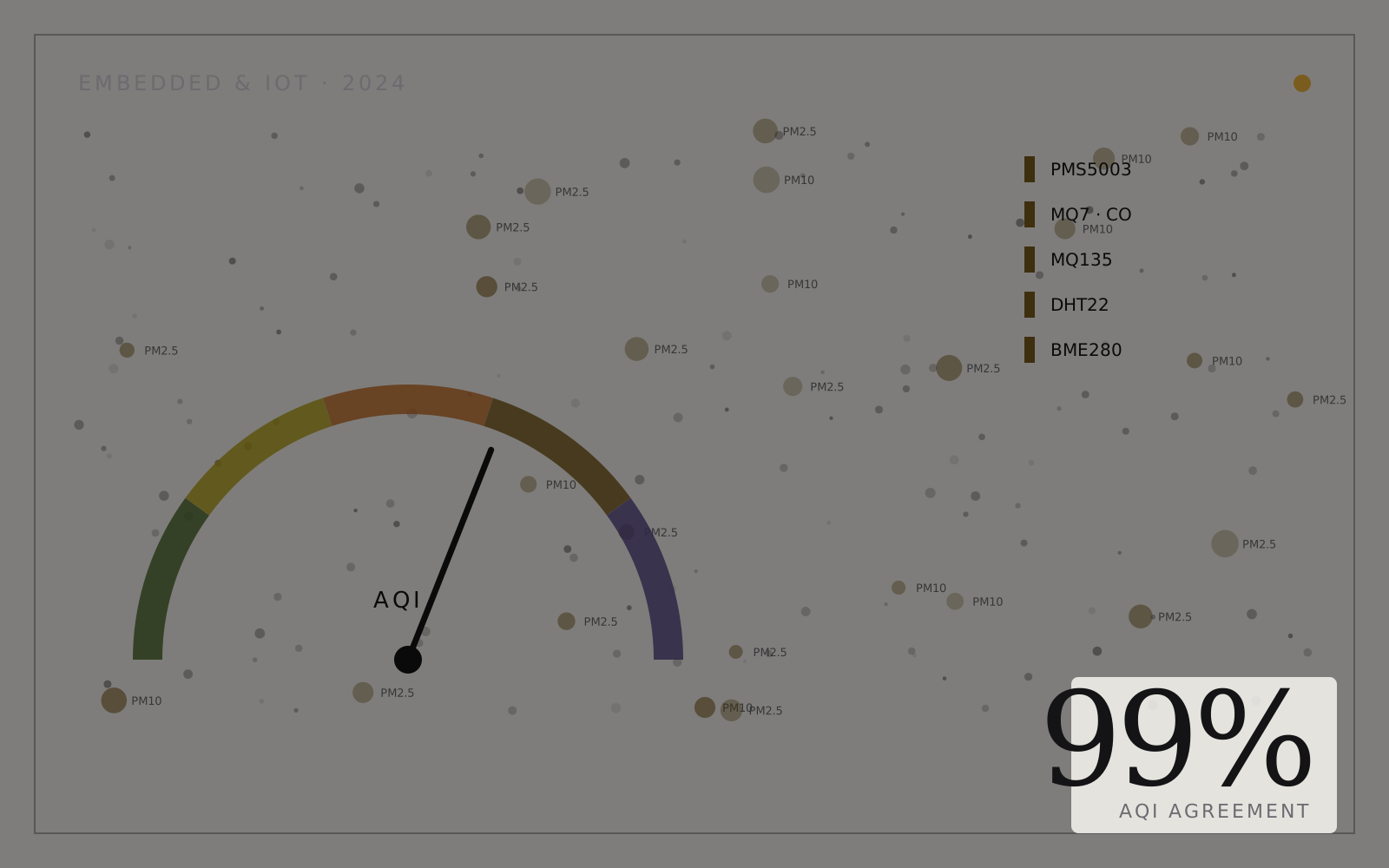
A low-cost air-quality node built around PMS5003, MQ7, MQ2, MQ135, DHT22 and BME280 sensors that measures PM2.5, PM10, CO, temperature, humidity and pressure. Many nodes deployed by many people form a distributed pollution map. Its AQI matched the official US Embassy Islamabad readings at 99% accuracy, and it seeded the BreatheSafe initiative.
README · rendered from GitHub
Crowd-Sourced AQI Monitoring System






Description
An IoT-based, community-driven air quality monitoring system designed to provide real-time AQI (Air Quality Index) estimation using multiple sensors. Built for both urban and rural coverage, this project empowers individuals to participate in environmental monitoring and decision-making.
Overview
This project presents a low-cost, scalable solution for air quality monitoring using IoT. It uses MQ-series gas sensors, particulate matter sensors, temperature & humidity sensors, and Bluetooth communication to calculate and visualize AQI in real-time.
What is AQI (Air Quality Index)? The Air Quality Index (AQI) is a standardized system used to measure and report the quality of air in a specific location. It tells you how clean or polluted the air is, and what associated health effects might be a concern for you.
- AQI ranges from 0 to 500.
- Lower AQI = cleaner air
- Higher AQI = more polluted air
| AQI Range | Air Quality | Health Impact |
|---|---|---|
| 0–50 | Good | Air quality is satisfactory |
| 51–100 | Moderate | Acceptable; some pollutants may affect very sensitive people |
| 101–150 | Unhealthy (Sensitive Groups) | May cause health effects for sensitive groups |
| 151–200 | Unhealthy | Everyone may begin to experience health effects |
| 201–300 | Very Unhealthy | Health warnings of emergency conditions |
| 301–500 | Hazardous | Health alert: everyone may be affected |
AQI is calculated based on concentrations of pollutants like:
- PM2.5, PM10
- CO (Carbon Monoxide)
- O₃ (Ozone)
- SO₂ (Sulfur Dioxide)
- NO₂ (Nitrogen Dioxide)
What is Crowd-Sourcing?
Crowd-sourcing is the practice of collecting data, services, or information by engaging a large number of people, especially from a community or public platform. In this project:
- Crowd-sourced AQI monitoring means many individuals place sensors in different locations (homes, streets, neighborhoods).
- These devices collect air quality data from multiple locations simultaneously.
- The data is combined to create a detailed and widespread pollution map, much more efficiently and cheaply than using a few government stations.
Hardware Used
| Component | Functionality |
|---|---|
| Arduino UNO | Main microcontroller |
| MQ135 | CO₂, NH₃, benzene detection |
| MQ7 | Carbon Monoxide (CO) |
| MQ2 | Smoke, LPG, Methane |
| PMS5003 | PM2.5, PM10 detection |
| DHT11 / DHT22 | Temperature & Humidity |
| BME280 | Pressure, Temp, Humidity |
| HC-05 Bluetooth | Mobile communication |
| 16x2 LCD Display | Real-time local display |
Block Diagram
System Design
My Crowd-Sourced AQI Monitoring System is designed using IoT architecture with low-cost, easily available hardware components. It consists of:
1. Sensor Unit
- Gas Sensors: MQ135, MQ7, MQ2 – detect CO₂, NH₃, CO, smoke, etc.
- Particulate Matter Sensor: PMS5003 – measures PM2.5 and PM10.
- Environmental Sensors: DHT11/DHT22 and BME280 – for temperature, humidity, and pressure.
2. Processing Unit
- Arduino UNO: Reads data from all sensors and processes it.
3. Display Unit
- 16x2 LCD: Displays real-time values of gas concentrations, PM levels, temperature, humidity, and calculated AQI.
4. Communication Module
- HC-05 Bluetooth: Sends processed data to a mobile app for visualization and logging.
5. Crowd-Sourcing
- Multiple such devices are deployed in various locations by different users (the crowd), forming a distributed monitoring network.
6. Optional Mobile App
- Receives real-time AQI data via Bluetooth.
Working Principle
1. Data Sensing
Each sensor continuously reads the concentration of gases (like CO, CO₂, NH₃), particulate matter (PM2.5, PM10), temperature, and humidity.
2. Data Processing
- Arduino processes the raw values.
- Using standard EPA formulas, it calculates the AQI for each pollutant.
- The maximum AQI among CO, PM2.5, PM10 is selected as the overall AQI.
3. Display and Transmission
- The AQI and sensor readings are shown on the LCD.
- The same data is sent to a connected mobile device via Bluetooth.
4. Crowd-Sourcing Model
- When many users deploy this system in different areas, a network of real-time AQI monitors is created.
- This increases the spatial coverage and data accuracy of air quality reports.
5. Validation
The system's output was compared with official AQI data from the US Embassy in Islamabad and showed 99% accuracy.
Sample AQI Calculation
| Pollutant | Concentration | AQI Value | AQI Category |
|---|---|---|---|
| PM2.5 | 162 µg/m³ | 212.5 | Very Unhealthy |
| PM10 | 170 µg/m³ | 108.4 | Unhealthy (Sensitive Groups) |
| CO | 0.32 ppm | 3.6 | Good |
| Overall AQI | — | 212.4 | Very Unhealthy |
Methodology
Results & Analysis
Taken on 19th December, 2024 – 10:42 PM – Islamabad
| Parameter | Value | AQI Value | Health Impact |
|---|---|---|---|
| PM2.5 | 162 µg/m³ | 212.40 | Very Unhealthy |
| PM10 | 170 µg/m³ | 108.42 | Unhealthy (Sensitive) |
| CO | 0.32 ppm | 0 | Good |
- Our AQI: 212.40
- Accuracy: 99% vs US Embassy AQI System
Future Work
Contributors
- Awais Asghar
- Muhammad Hammad Sarwar
- Muhammad Ashar Javid
- School of Electrical Engineering & Computer Science (SEECS), NUST
More in Embedded
Related projects
 Embedded2025
FreeRTOS Smart Energy Monitor
STM32F746 tasks compute Vrms, Irms and kWh; an ESP32 pushes it to a cloud dashboard.
- STM32F746
- FreeRTOS
- ESP32
- C/C++
 Embedded2024
Fully Automated Egg Incubator
ATmega328P climate control and egg turning that hatched every pigeon egg in 18 days.
- ATmega328P
- Arduino IDE
- Atmel Studio
- Proteus
 Embedded2024
Smart Health Tracking System
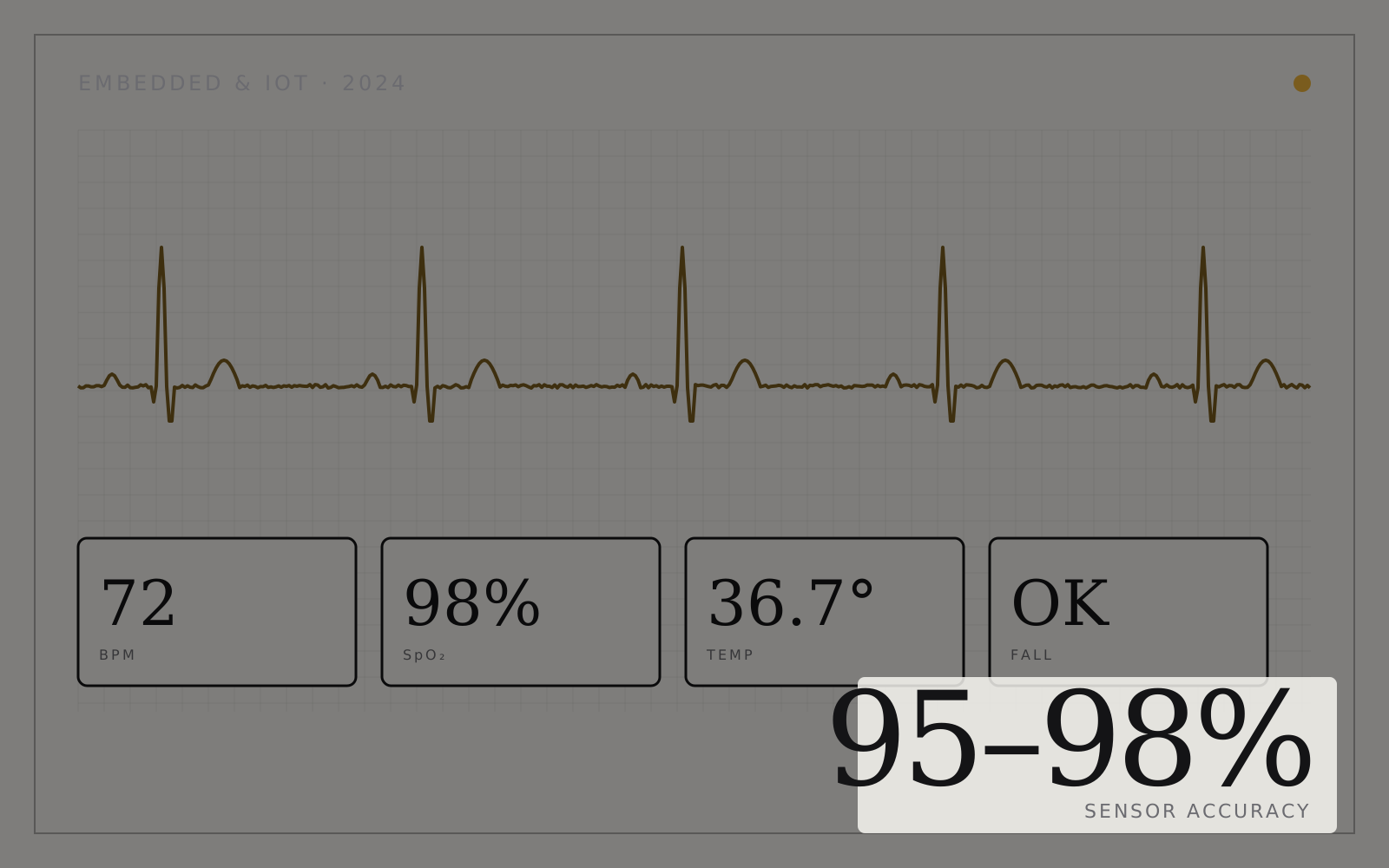
ECG, SpO₂, heart rate, temperature and fall detection on one wearable node.
- Arduino UNO
- C/C++
- AD8232
- MAX30100