Lightweight U-Net for Driving Scenes
A U-Net compressed from 8.7M to 0.53M parameters without losing the skip connections.
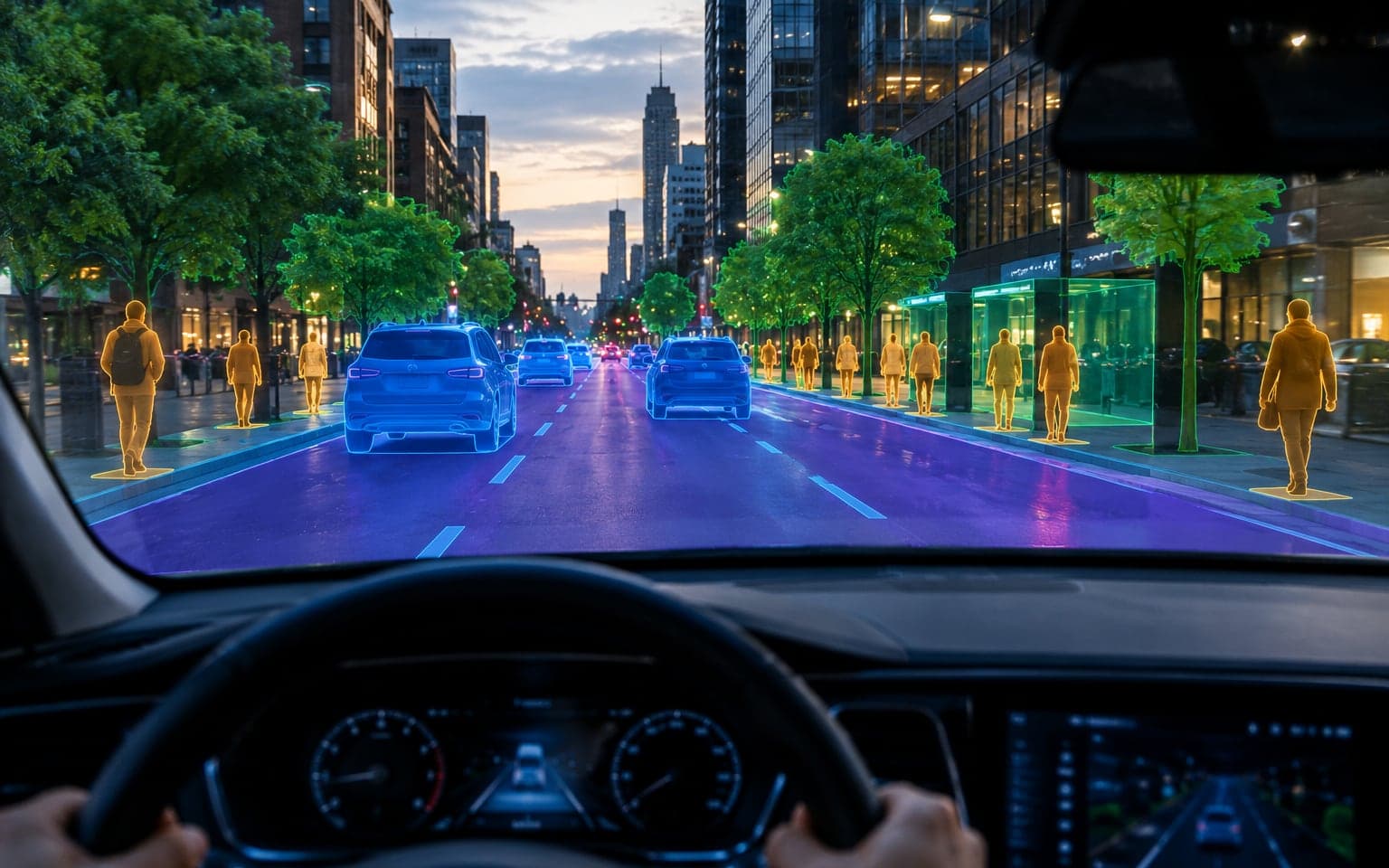
Pixel-wise semantic segmentation of CARLA simulator scenes into road, vehicles, pedestrians, buildings, vegetation and background. The novel lightweight variant keeps the encoder-decoder structure while cutting parameters sixteen-fold, and still reaches 72% IoU, 80% F1 and 96% test accuracy. It became the model family behind the FPGA accelerator.
README · rendered from GitHub
Autonomous Driving Scene Segmentation with U Net





Autonomous vehicles require pixel level understanding of the environment for safe navigation. Traditional computer vision methods fail in complex situations like occlusions, shadows, bright lights, rain, and urban clutter. The challenge is to segment CARLA road scene images into meaningful classes including roads, vehicles, pedestrians, sidewalks, buildings, vegetation, sky, and background. U Net provides an effective end to end learning solution for pixelwise segmentation. This project uses a U Net based deep learning model to perform pixel level semantic segmentation on CARLA simulator images. The goal is to classify each pixel of a driving scene into categories such as road, vehicles, pedestrians, buildings, vegetation, and background. The project demonstrates how deep learning improves scene understanding for autonomous driving systems.
Dataset Information
Dataset Source: CARLA Simulator Semantic Segmentation Dataset This dataset includes synthetic driving scenes with perfectly labeled ground truth masks.
Contents:
- Around 5000 RGB images
- Each image has a corresponding pixel labeled segmentation mask
- Classes include road, vehicles, pedestrians, buildings, vegetation, road lines, poles, sky, etc
- Data is divided into: dataA, dataB, dataC, dataD, dataE (folders)
Advantages:
- Pixel perfect labels
- No noise or annotation errors
- Helps build strong baseline models before moving to real datasets
Data Preprocessing
Steps included in the project:
- Load RGB input images and their ground truth segmentation masks
- Resize all images and masks to a consistent shape (256 × 256)
- Normalize pixel values to [0, 1]
- Convert masks into one hot encoded format for multi class prediction
- Visualize image–mask pairs to ensure correct alignment
- Split into training, validation, and test sets
Purpose: Preprocessing ensures the model receives uniform and clean inputs, improving accuracy and convergence.
U Net Model Architecture
The model follows the original U Net structure:
Encoder
- Repeated Conv2D + ReLU
- Max Pooling layers
- Extracts features and reduces spatial dimension
Decoder
- Transposed Convolutions (upsampling)
- Reconstructs image resolution
- Combines encoder features using skip connections
Skip Connections
- Transfer fine spatial details directly from encoder to decoder
- Help the network learn thin and small structures such as road markings or poles
Output Layer
- Produces a multi class segmentation map
- Each pixel receives a probability for each class
Training Configuration
Loss Function: Categorical Cross Entropy Optimizer: Adam Hyperparameters:
- Batch size: 32
- Epochs: 20
- Learning Rate: 0.001
- Validation split: 20 percent
Training Tools:
- ModelCheckpoint: saves best model
- EarlyStopping: prevents overfitting
Model Performance
Training Accuracy: 98.77 percent Validation Accuracy: 98.67 percent Test Accuracy: 98.58 percent
These results show that the model correctly learns scene features and generalizes well across unseen images.
Evaluation Metrics
The following metrics were used:
- Accuracy: percentage of correctly predicted pixels
- Precision: correctness of predicted positive pixels
- Recall: ability to detect all true positive pixels
- Specificity: ability to avoid false positives
- Mean Intersection over Union (mIoU): overlap between prediction and ground truth
- F1 Score / Dice Coefficient: harmonic balance between precision and recall
- True Detection Rate (TDR): how accurately the target object is segmented
These metrics provide both pixel level and class wise performance insights.
Results and Visualizations
The project demonstrates:
- Predicted segmentation maps compared with ground truth masks
- Overlay of predictions on original RGB images
- Clear separation of objects such as roads, vehicles, sidewalks, and buildings
- High quality reconstruction of scene elements
Visual outputs prove that U Net can reliably interpret complex driving scenes.
Key Observations
- Strong performance on structured objects like roads and buildings
- Good detection of vehicles and pedestrians
- Minor confusion in thin structures such as poles and wires
- Dataset quality helps training stability
Tools Used
- Python
- TensorFlow or PyTorch
- NumPy
- Matplotlib
- CARLA Simulator dataset
- Jupyter Notebook
Conclusion
This project successfully implements U Net for multi class semantic segmentation on CARLA driving scenes. The model achieves high accuracy and strong segmentation quality, demonstrating the usefulness of U Net for autonomous driving perception tasks.
By converting raw images into pixel level class maps, the system supports decision making in tasks like navigation, lane detection, path planning, and obstacle avoidance.
Future Improvements
- Add data augmentation (brightness, rotation, weather effects)
- Use Dice loss or combined BCE + Dice loss
- Incorporate Attention U Net or DeepLabV3+
- Train on real world datasets for better robustness
- Convert the model for edge deployment or real time inference
More in Vision
Related projects
 Vision2025
Real-Time Fabric Defect Detection
Six classical detectors fused by IoU, running live on a Jetson Nano.
- Python
- OpenCV
- NumPy
- SciPy
 Vision2025
Retinal Vessel Segmentation
A clean, reproducible U-Net pipeline for segmenting blood vessels in fundus images.
- Python
- PyTorch
- OpenCV
 Vision2025
Stereo Depth Estimation
Disparity and depth maps from a calibrated stereo pair, with classical vision only.
- Python
- OpenCV
- NumPy